ElderGuard

The Idea
This is a concept from my Year 3 Mobile Robotics module — a concept only, it was never built. My teammate on this was Haziq.
ElderGuard is an assistive mobility robot for elderly patients in hospital and rehab wards, meant to help them get to the canteen, the toilet, or visit friends in another ward without needing a nurse free to walk with them.
We also recorded an interview walking through the idea, embedded below.
Problem Framing
- Big Idea: assisting the mobility of elderly patients in hospital and rehab spaces.
- Essential Question: elderly patients want to go for walks, to the canteen, to the toilet, or to meet friends in a different ward — who has the time to walk with them?
- Challenge: nurses have low manpower to walk the elderly. Sometimes one nurse needs to attend to 10 patients, a 1:10 nurse-to-patient ratio that makes dedicated one-on-one walking time almost impossible. When a single nurse is balancing medication rounds, vital signs, hygiene, and emergency calls, walking with the elderly stops being a priority — not out of neglect, but because other responsibilities come first. The elderly may want to walk because they feel confined to their space, but because they're frail, they carry a higher risk of falling. What could be built to let them walk while preventing injuries?
Robot Sketches
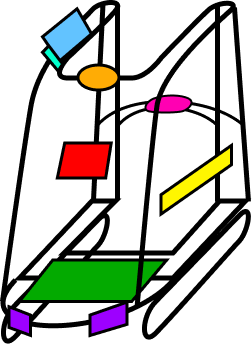
Below is the annotated concept sketch, labelling the planned sensors and outputs: a touch-sensitive visual display, a microphone, a camera, an IMU alongside the battery management system and voltage regulators, an ultrasonic sensor, a LiDAR sensor, LED directional alerts, and motor drivers. There's also a safety seat the elderly could attach a harness to in case of a fall, and handles on the sides rather than the front, so there'd be no need to lean forward to hold on.
Sensors and Outputs
The same 1:10 nurse-to-patient ratio came up again once we looked at the technical side: a high ratio means nurses have to care for many patients at once, and when a nurse needs to leave the ward to transport one patient, there may not be enough staff left to watch the others — raising the risk of both safety issues and nurse burnout. That framed which sensors and outputs we'd need and why.
Sensors:
- Vision sensor (camera): high-definition cameras for obstacle recognition and identifying who the user is.
- LiDAR: for SLAM (Simultaneous Localization and Mapping) and obstacle avoidance.
- Ultrasonic sensor: for immediate proximity detection of low-profile obstacles.
- Microphone: senses speech from the elderly user — can tell the robot which location to go to, and can call for assistance from the nurses if needed.
- IMU/odometer: for precise motion control and localization within the workspace.
Outputs:
- Motor drivers: control the movement of the robot.
- Touch-sensitive visual display: for the elderly to interact with, such as choosing where to go.
- LED directional alert system: shines light to direct the elderly along the correct path.
- Speaker: provides audio feedback to the elderly user.
What It Would Cost
We also costed out a realistic single-unit bill of materials, using industry-grade parts we could actually find purchase links for, with prices in SGD including shipping to Singapore.
Chassis & Structure — subtotal S$12,289.32
- AgileX TRACER 2.0 two-wheel differential AGV (150kg payload, 400W motors, 2m/s max speed, 30Ah battery for up to 80km range) — S$11,749.32
- Aluminium body panels, 6061-T6, 3mm, cut-to-size and anodized — S$260.00
- Stainless steel base/structural plates, 304, 3mm, laser-cut — S$280.00
Input — Sensors — subtotal S$4,241.25
- Intel RealSense D435i vision sensor — S$463.10
- SICK TiM571-2050101 2D LiDAR (industrial safety-rated) — S$2,431.65
- MaxBotix MB7389-100 HRXL ultrasonic sensors (x4) — S$586.70
- ReSpeaker Mic Array v2.0 microphone array — S$219.30
- Analog Devices ADIS16470AMLZ IMU — S$540.50
Processing — subtotal S$735.20
- Raspberry Pi CM4 8GB + MyPi Industrial IoT carrier board — S$367.70
- OpenCR 1.0 real-time interface — S$296.60
- Akasa Pi-4 Pro aluminium enclosure and cooling — S$70.90
Output (Actuation, Display & Alert) — subtotal S$3,032.10
- DYNAMIXEL XM540-W270-R drive motors (x2) — S$1,307.80
- ODrive S1 industrial servo controller — S$218.00
- Partaker 10.1in IP65 industrial touch panel PC — S$882.35
- Patlite LR6-3USBW-RYG LED directional alert tower — S$545.25
- Visaton FRS8-8 speaker + Class-D amplifier board — S$78.70
Power — subtotal S$1,248.95
- Manly Battery 24V 20Ah LiFePO4 industrial pack — S$599.85
- Daly Smart BMS 8S 24V + Mean Well DDR-60 DIN-rail converters — S$273.05
- Schneider XB4BS8442 E-stop + M12 industrial harness — S$376.05
Grand total, single-unit BOM, SGD, including shipping: S$21,546.82
Software Architecture
For a real build, the plan was to run everything on ROS 2, with Nav2 for navigation and SLAM Toolbox for mapping, and robot_localization to fuse the IMU, odometry, and camera data into a reliable pose estimate. Each sensor and actuator would sit behind its own driver:
- Vision sensor (Intel RealSense D435i): the realsense-ros driver on top of the librealsense SDK.
- LiDAR (SICK TiM571): the sick_scan_xd driver.
- Ultrasonic sensor (MaxBotix MB7389): there is no drop-in ROS driver for this one — it would need a small custom node built on micro-ROS/micro_ros_arduino.
- Microphone (ReSpeaker Mic Array v2.0): the respeaker_ros driver for direction-of-arrival, voice activity detection, and audio topics, plus the usb_4_mic_array firmware/low-level utilities.
- IMU (Analog Devices ADIS16470): the adi_driver ROS driver.
- Motor drivers (ODrive S1): the official ros_odrive ROS 2 integration, including odrive_ros2_control.
Hardware Block Diagram
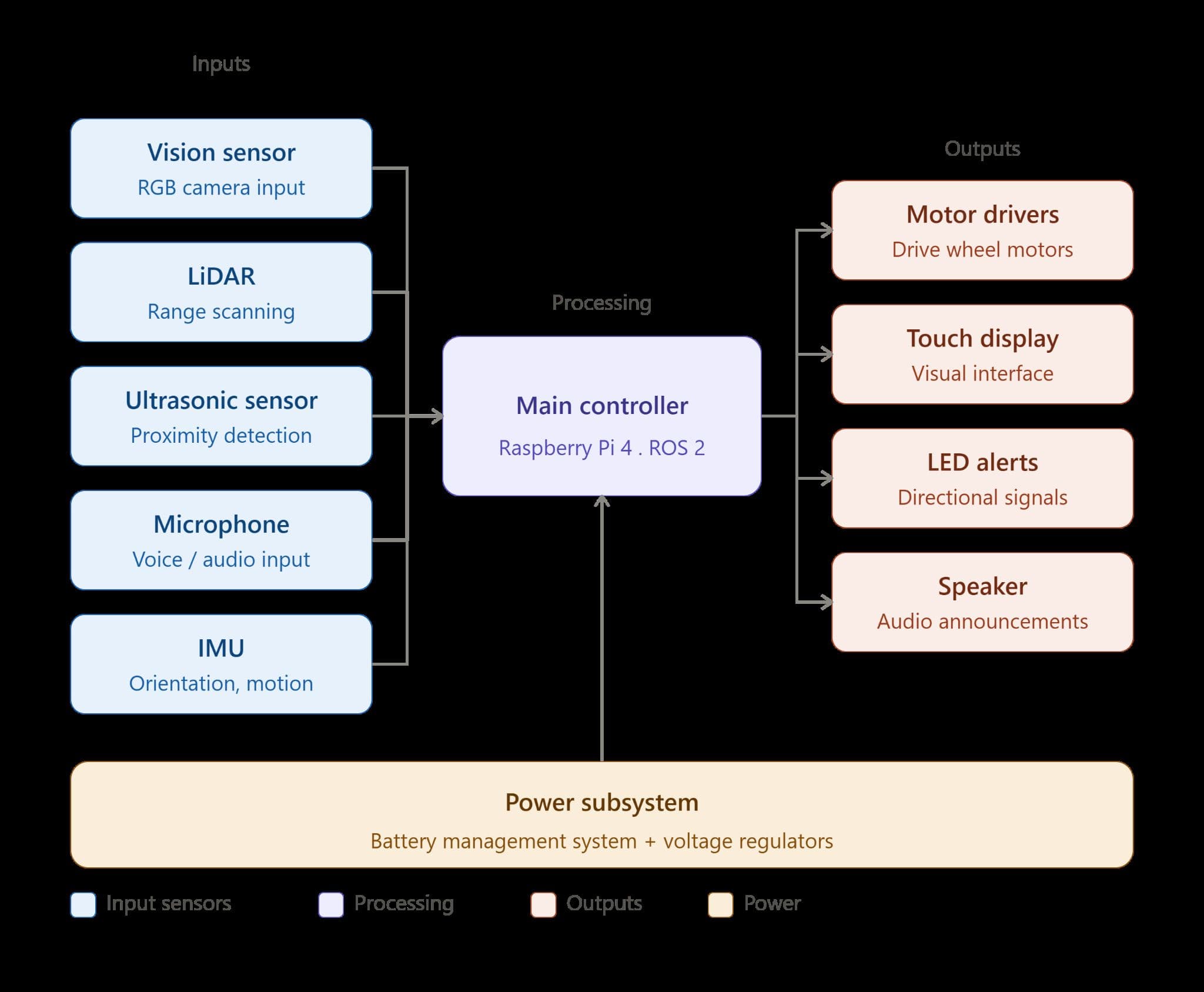
The hardware block diagram lays out the system as inputs, processing, outputs, and power:
- Input blocks: vision sensor (camera), LiDAR, ultrasonic sensor, microphone, IMU.
- Processing blocks: the main controller running ROS 2 (e.g. a Raspberry Pi 4).
- Output blocks: motor drivers, touch-sensitive visual display, LED directional alert systems, speaker.
- Power blocks: battery management system and voltage regulators.